

Part I — The Age of the Saints
Lessons in story, distinctiveness and stance
More than 670 place names in Wales begin with the prefix Llan: Llanddewi, Llanelli and Llanilltyd — to name just a few.
You can’t look at any Welsh map, or ask for directions to anywhere, without encountering dozens of them. Even if your destination isn’t a Llan-something-or-other, there will be at least a handful serving as not-easy-to-miss, not-easy-to-say waypoints. More than geography, these names graph the spread of stories.
"More than geography, these names graph the spread of stories."
Every one of them celebrates the life of a saint. Either a saint founded that community, or created a movement that rippled out and established new centres in their patron’s name. This must have been a pretty competitive business back in the day, as more than a few celebrate their founding with a posse of the pious — Llantrisant being a famous example.
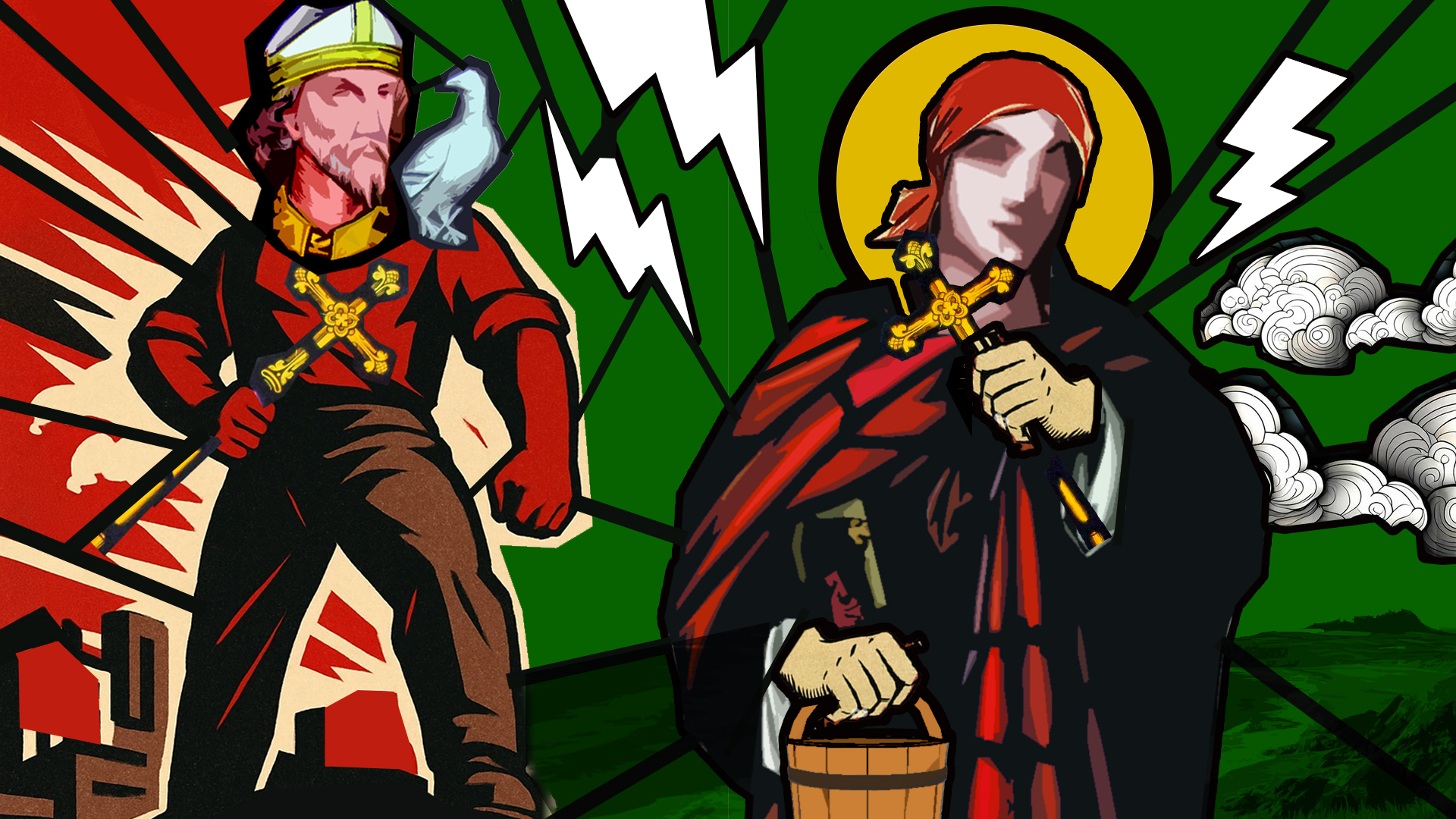
Back in the day? We’re talking about the Age of the Saints in Wales, roughly from 450 to 600 AD. Rolling like thunder from the east, Germanic tribes were striking westwards. Seemingly unstoppable, they brought violence and displacement, chaos and paganism. Out on the great Atlantic peninsulas of Britain, a people who felt themselves in some ways Celtic, Roman and Christian, needed to find a response.
"Saintliness maybe wasn’t the obvious choice."
But this was a grass roots movement, not a top-down strategy. These saints made themselves. They were anointed by their followers, not appointed by committee. They were in charge of their own stories. With the exception of a few well known ones like Dewi — St David — those are just a few of the reasons why you won’t find them in the canonical rolls.
"They were anointed by their followers, not appointed by committee."
Also, they were maverick and colourful. Rule makers and rule breakers. Even as they stood for learning, order and structure, they were also rooted to the landscape, language, and myths of their people. They scaffolded, re-rendered and ornamented a culture that was evolving even as — and exactly because — it was threatened by erasure.
That they met the moment forcefully, colourfully, credibly and convincingly is there on the map for everyone to see.
Their lesson for our times is how to make and tell a story about distinctiveness, purpose and values, in a language that sets its own tone. And about how not to be overwhelmed by the chaos of consensus and the liturgy of LinkedIn.
Which raises a useful question for modern storytellers: what actually makes a story saintly? Because every good story still lives somewhere between sins and miracles.
Part II — Seven Sins of positioning
A field guide for modern day storytellers
Most companies don’t struggle with momentum because they lack effort. They struggle because they lack clarity. When positioning is clear, the story spreads. When it isn’t, marketing has to compensate.
What Wales’ saints demonstrated convincingly, modern brand sometimes forget. So here is a field guide to avoiding the sins — and working the small miracles — of positioning.
1. The sin of trying to appeal to everyone
Broad positioning feels safe
But safe positioning disappears.
Saying you work with “organisations looking to innovate and grow” isn’t useful from a marketing point of view. It’s too broad. When you dilute the message to attract more people, you fade into the background.
The Miracle
Define exactly who you’re for and let the wrong audience walk away.
| Strong positioning repels as well as attracts
2. The sin of describing what you do instead of why it matters
Services explain mechanics.
Positioning explains impact.
Lines like “we offer integrated cyber-security solutions” or “leading provider of information security networks” can be seen everywhere.
That’s because most brands explain their services. Very few articulate the transformation they create.
The Miracle
Lead with the shift you create in the customer’s world, not the mechanics behind it.
| Positioning is about stakes, not services
3. The sin of sounding like everyone else
Professional language often sounds safe.
Unfortunately, it also sounds identical.
A lot of B2B copy feels interchangeable because it’s written to sound “professional” instead of distinctive.
Try this: If you removed your logo from your homepage, could it belong to five other companies in your space?
The Miracle
Articulate a clear point of view about the problem you solve.
| Point of view builds authority
4. The sin of empty superlatives
If everyone is “best of breed,” no one is.
“Best of breed.”
“Market-leading.”
“World-class solutions.”
When everyone claims superiority, the claim stops meaning anything.
Buyers don’t trust big claims without proof. And most of the time, those phrases are doing one thing: covering up unclear differentiation.
The Miracle
Replace empty superlatives with specific truth.
Explain what actually makes your approach different and why that difference matters.
| Specificity builds credibility
5. The sin of strategic shape-shifting
Constant change rarely signals strategy.
It usually signals uncertainty.
Every year: new tagline. New messaging angle. New rebrand-lite.
Repositioning because the market moved is smart.
Repositioning because you’re uncertain is rarely strategic — and always expensive.
The Miracle
Do the deep clarity work once, so your story holds under pressure.
| When positioning is solid, confidence grows and execution becomes simpler
6. The sin of internal story confusion
If leadership isn’t aligned on the story, the market never will be.
Ask five leaders in your company what you stand for. If you get five different answers, that’s not a marketing issue. It’s a narrative leadership issue.
The Miracle
Align internally on:
- Who we are
- Who we serve
- What problem we exist to solve
- What we refuse to become
| Clarity internally creates power externally
7. The sin of playing small in your own story
Confidence is part of positioning.
Some brands understate their value because they’re afraid to sound bold. So they soften the message. They hedge. They hold back.
Buyers can feel it.
And when a company sounds unsure of its own value, the market rarely steps in to correct that.
The Miracle
Name the stakes
Name the cost of staying stuck
Have the courage to occupy space
| Strong brands don’t need to shout. But they do speak with conviction
The real miracle: clarity
Most growth problems aren’t demand problems. They’re clarity problems.
When your positioning is vague, marketing has to work twice as hard.
When your story is sharp, everything else gets easier.
Clarity aligns teams.
It sharpens decisions.
It gives your marketing something powerful to build on.
And when the story finally clicks — inside your company and in the market — momentum builds naturally.
The old saints of Wales would probably recognise the pattern.

What do you think?