

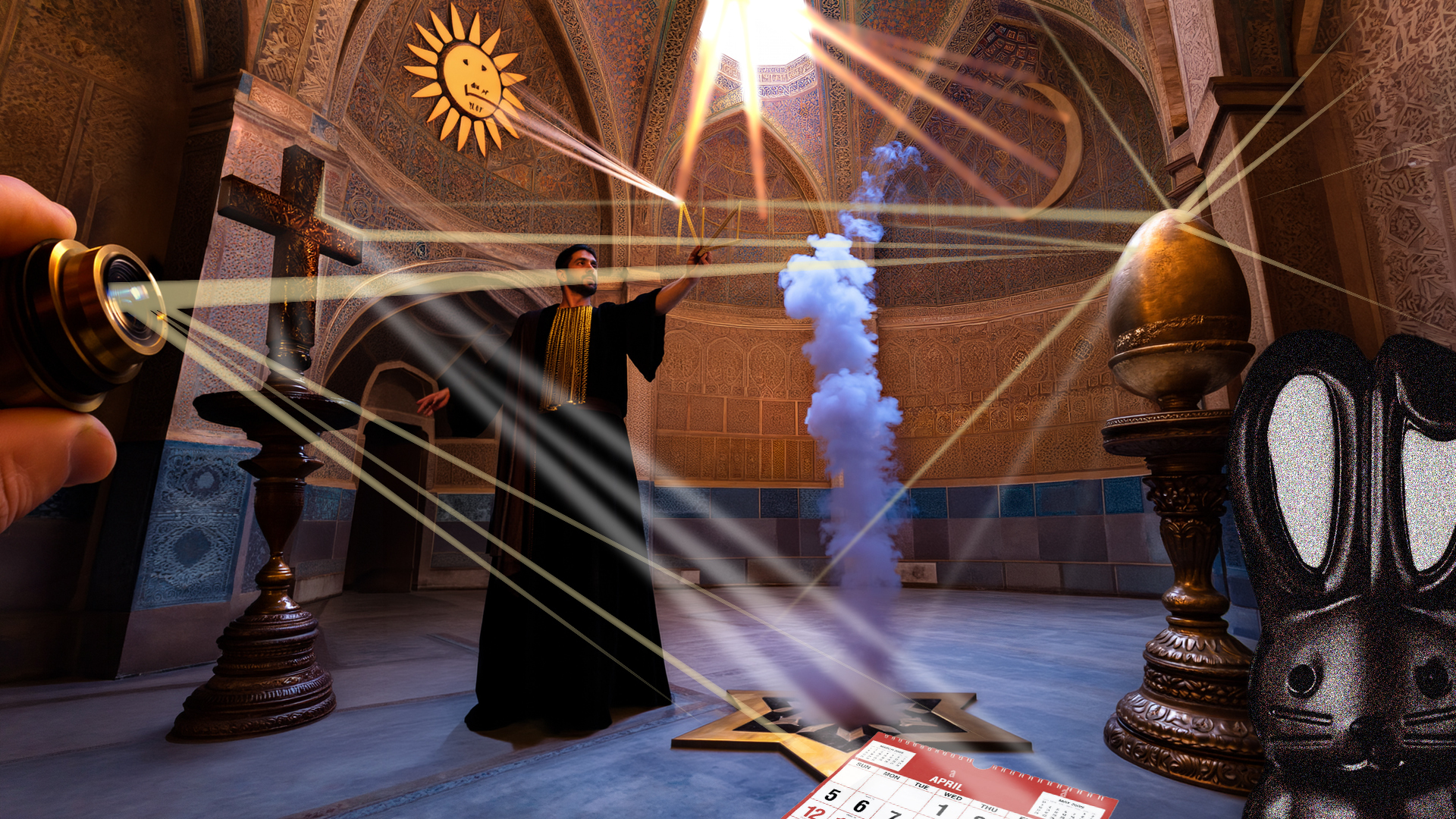
Start here and do this:
</> Look up the date of the Northern Equinox
</> Pinpoint the full moon that comes after it
</> Slide your finger forwards along the calendar to the following Sunday
Stop there.
Congratulations! You have just put your finger on Easter, algorithmically speaking. Now you’ve done it once, you can do it every year and no one will disagree with the moment you chose. It doesn’t matter which calendar they live by. Easter Day is triangulated, unmistakably and repeatably. Did you ever imagine you had such power at your fingertips?
An ancient algorithm
But why an algorithm? When the Christian church was still young, two saints from different traditions met to settle a dispute about the date of Easter. You’d imagine both resonated with the mysterious: but whereas one looked for divine revelation, the other sought certainty in the records of theocracies and empires. The mystic meets the accountant: you might think not the easiest of relationships.
Given that — or maybe because of it — their solution was astonishing. Not some statistical average plus or minus a few standard deviations. Not a random date scraped from a lurid dream or a scrap of dodgy old parchment either. Instead, a set of instructions embracing theology and astronomy — but still managing a whiff of mysticism — allowing a fresh date to be calculated each year, and yet contained within a range in which all traditions could see themselves reflected.
Who does it belong to?
You just used the algorithm, but who does it belong to? Anyone that can read a calendar and look at the sky. No passwords and no small print. The word algorithm is Arabic and medieval in origin, and it arrived in Europe from Persia and a culture dedicated to creating and sharing knowledge. Your grandma’s infallible sponge cake recipe is an algorithm that aligns exactly with that philosophy.
But we’ve all cooled on algorithms lately. Outside of the air-gapped boardrooms of Silicon Valley, it’s rare for algorithms to fill anyone with a sense of empowerment, liberation, choice, or wonder. The words we’d associate now are secret, proprietary, manipulative, invasive, addictive. We’ve all got the bruises.
How algorithms got complicated
How did we go from where we started, to where we are? Partly, it’s because we’ve been led to expect the apps we crave to be ‘free’ to use. The freemium business model — like the casino business model — depends on manipulation, extraction and addiction. Partly, it’s because markets value a ‘secret sauce’ more for the secrecy than the flavour. As consumers, we don’t need to know the full code set to be able to responsibly and safely tune the outputs of these algorithms to create better outcomes for ourselves. But it’s more profitable to keep the algorithms locked away in their freemium black boxes, regardless of the mounting costs to privacy and mental health, and the polarisation of public opinion.
The Easter Principle
The Easter Algorithm shows us that it doesn’t have to be this way. It is transparent, and tunable by anyone with basic knowledge. It was built to serve, not to extract. These aren’t nostalgic, poetic qualities. These are design principles.
Heinz prints its ketchup recipe on the back of every container and trusts us to use it any way we choose. Or leave it at the back of the fridge for months on end. There are still enough secrets inside the bottle to keep us guessing. That business model has sustained itself, and us, for 150 years.
What you can do about it
When Big Tech puts an algorithm into a black box, it is out of greed, not need. It’s more than a business model — it’s an extraction model. Governments are beginning to regulate, but you and I can move faster.
If you don’t absolutely need them, ditch them.

What do you think?