

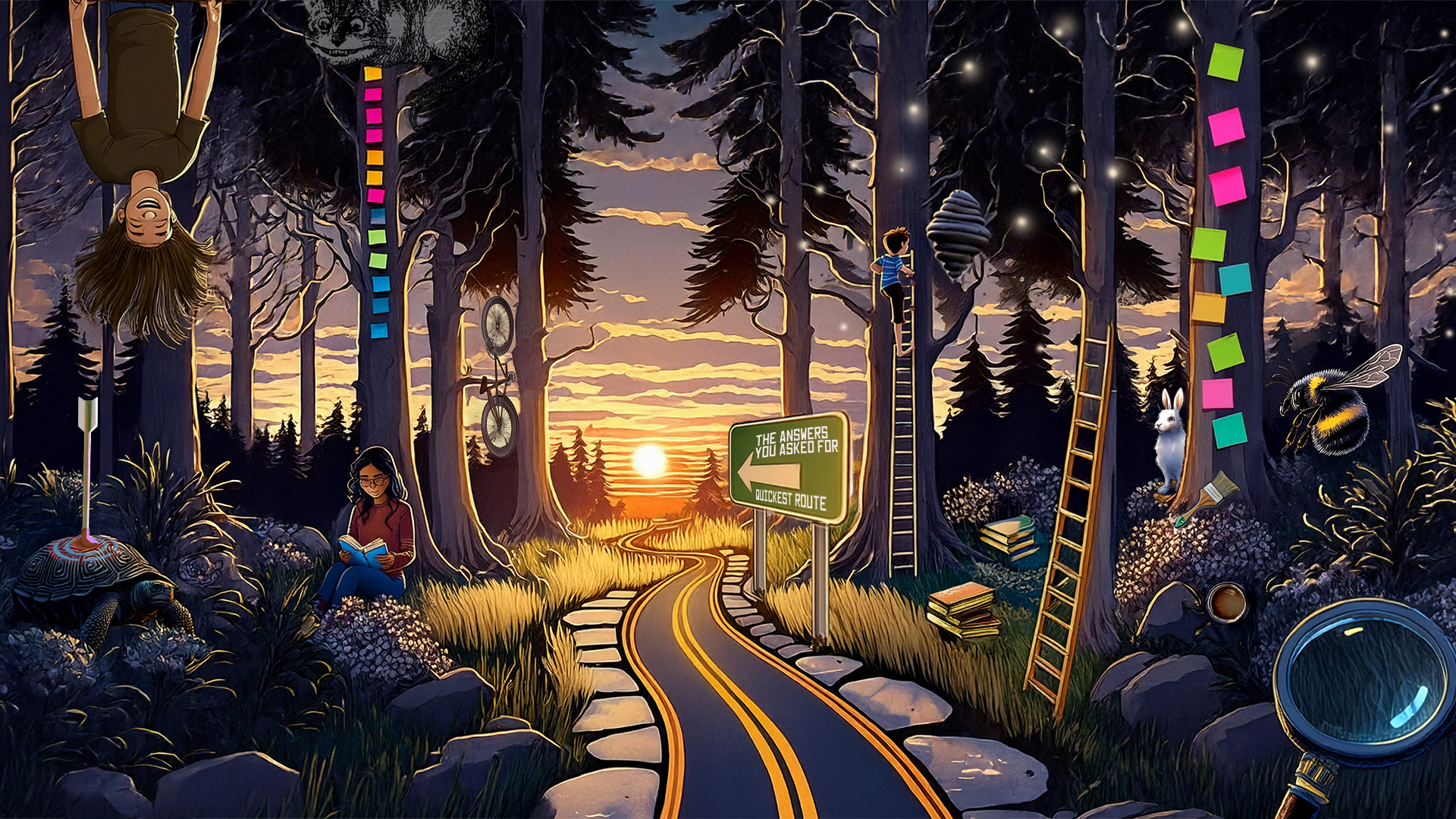
When I was young, intelligence was measured by how well you answered questions. Today, I would argue it’s about how well you question answers!
A world of instant answers
That feels important. Because we now live in a world where answers arrive instantly. Summarised. Synthesised. Confidently delivered by machines trained on almost everything humans have ever written. Ask AI a question and within seconds you can get a strategy, a diagnosis, a business idea, a poem or even a life plan.
It’s extraordinary. But it may also be accelerating us to average.
"Is it accelerating us to average?"
Which raises a bigger question: what happens to curiosity in a world increasingly optimised for certainty
Because curiosity is rarely efficient. It wanders. It lingers. It scratches around. It opens tabs you never intended to open. It follows strange threads. It notices things that don’t quite fit.
Historically, that’s often where discovery begins.
Penicillin was discovered because Alexander Fleming noticed mould behaving strangely in a contaminated petri dish rather than simply throwing it away. The Microwave oven exists because engineer Percy Spencer became curious about why a chocolate bar had melted in his pocket while working with radar equipment. And Post-it Notes were born after somebody asked whether a failed adhesive might solve a completely different problem.
Some of the world’s most important discoveries didn’t emerge from certainty or optimisation. They emerged because somebody noticed something odd, resisted the urge to dismiss it, and stayed curious long enough to ask a better question.
The declining curiosity curve
Long before artificial intelligence, curiosity drove humans to cross oceans, craft cave paintings, invent telescopes, map stars and ask what might exist beyond the horizon. So why do many of us appear to lose it over time?
In the late 1960s, NASA scientist George Land tested 1,600 children aged four and five for creative thinking. Around 98% of the children scored at what he described as “genius” levels. Five years later the figure had dropped to 30%. By adulthood it reportedly fell to around 2%.
That decline mirrors something else researchers have long observed. Human beings appear to reach peak ‘curiosity’ somewhere around the age of five. One UK study estimated that children at that age ask as many as 300 questions a day. At that age, curiosity is almost relentless.
"Humans reach peak curiosity by age 5"
Then somewhere between the classroom and the boardroom, many of us seem to lose it. Not because curiosity disappears completely, but because we gradually become conditioned towards certainty. Towards getting the answer right. Towards speed, efficiency and performance. We learn that confidence is rewarded more than wondering.
School systems, workplaces, algorithms and social platforms often reinforce this. We are encouraged to optimise. Move faster. Become more decisive. Less time is spent lingering with uncertainty or following ideas without knowing exactly where they will lead.
And perhaps that’s part of the tension emerging in the age of AI. Because while optimisation is useful, we probably shouldn’t aspire to optimise being human.
The value of human inefficiency
Humans are messy. Emotional. Contradictory. Irrational. Loving. Creative. Curious. We daydream, procrastinate, fall down rabbit holes. Change our minds halfway through conversations and become fascinated by things that have no obvious commercial value whatsoever.
We are, in many ways, efficiently inefficient. And thank goodness for that.
"Some of the best breakthroughs humans have ever made began with uncertainty"
Imagine a world where humans became fully optimised for sameness. The same answers. The same recommendations. The same opinions. The same routes through life generated by the same systems trained on the same data.
Efficient? Perhaps. Interesting? Probably not.
Discovery rarely comes from optimisation. It usually comes from friction. From anomalies. From people willing to ask awkward questions or follow strange fascinations slightly further than everyone else. Some of the best breakthroughs humans have ever made began with uncertainty. A wrong turn. A strange result. A rabbit hole.
Commercial curiosity
Businesses that stay relevant often understand the power of curiosity too.
LEGO recovered from the brink of collapse in the early 2000s by becoming curious again. Curious about play. Curious about creativity. Curious about why children and fans connected so deeply with a simple brick.
Pixar built a culture around questions rather than hierarchy. Directors were encouraged to expose unfinished ideas early, challenge assumptions and stay open to unexpected directions. Curiosity became part of the creative process rather than a distraction from it.
3M became one of the world’s most innovative companies not by demanding certainty, but by creating space for experimentation, wandering and unexpected discovery, which famously led to the humble Post-it Note.
The companies that endure are often the ones that remain interested.
Bee more curious
Even bees seem to understand the value of curiosity. Honey bees perform something called the waggle dance — a remarkable behaviour where foraging bees communicate the precise direction and distance of rich nectar sources back to the hive. It’s nature’s version of optimisation. Clear instructions. Reliable information. Efficient outcomes.
But not all bees follow the dance.
Researchers have observed that a small proportion of bees, often estimated at around 20%, ignore the instructions completely and fly off to explore independently for new sources of nectar.
The explorers matter. They are the ones that discover new opportunities, adapt to changing environments and stop the colony becoming dangerously dependent on existing answers. Even nature appears to understand that survival depends not just on efficiency, but on curiosity.
Live long and curiously
The same is true in life. The most interesting people are rarely the ones convinced they already know all the answers. They’re the ones still asking questions. Still listening. And still prepared to say:
“That’s strange.”
“I wonder why.”
“I hadn’t thought of it like that.”
That matters in today’s world because AI has become astonishingly good at producing answers. But answers alone are not wisdom. And convenience alone is not thinking. We should absolutely embrace AI. Use it to explore. Test ideas. Accelerate learning. Challenge assumptions. Perhaps we need a slightly bi-curious relationship with it.
But let’s not outsource our thinking entirely.
Let’s not always accept the first answer we arrive at. Dig deeper. Scratch around. Peel back the layers. Go down a rabbit hole, or two. You may not find a better answer. But you might find a better question.
In the years ahead, that may become one of humanity’s most valuable human skills.
Stay curious people.
What do you think?